

Oil Transformer
Your Professional Oil Transformer Supplier
Hebei Hozee Electric Co., Ltd., a professional Chinese distribution transformer manufacturer registered in Shijiazhuang, Hebei, adheres to "Efficient, Intelligent, Green" and is led by founder/CTO Liu Yanchao (15+ years in transformers) and his team of senior engineers (avg. 8+ years, mastering IEC/GB standards).It provides customized solutions (for voltage, working conditions, load) to serve domestic industrial/new energy/grid upgrade markets and over 50 countries globally. Future-focused on tech innovation, aiming to support the global energy transition.
-
![200KVA Oil Immersed Transformer]() 200KVA Oil Immersed TransformerRated power: 200KVA oil immersed transformer core and winding assemblyread more
200KVA Oil Immersed TransformerRated power: 200KVA oil immersed transformer core and winding assemblyread more
Primary voltage: 13200V
Secondary voltage: 400V
Impedance:4±10%
Frequency:50hz -
![250 Kva 3 Phase Transformer]() 250 Kva 3 Phase TransformerRated power: 250 kva 3 phase transformerread more
250 Kva 3 Phase TransformerRated power: 250 kva 3 phase transformerread more
Primary voltage: 11000V
Secondary voltage: 400V
Impedance:4.%
Connect groups:Dyn11 -
![15kva 3 Phase Transformer]() 15kva 3 Phase TransformerRated power: 15Kva single phase transformerread more
15kva 3 Phase TransformerRated power: 15Kva single phase transformerread more
Primary voltage: 13800V
Secondary voltage: 120/240V
Impedance:2% -
![50kva Single Phase Transformer]() 50kva Single Phase TransformerRated power: 50Kva single phase transformerread more
50kva Single Phase TransformerRated power: 50Kva single phase transformerread more
Primary voltage: 13800V
Secondary voltage: 120/240V
Impedance:2% -
![75 Kva Single Phase Transformer]() 75 Kva Single Phase TransformerRated power: 75Kva single phase transformerread more
75 Kva Single Phase TransformerRated power: 75Kva single phase transformerread more
Primary voltage: 13800V
Secondary voltage: 120/240V
Impedance:2% -
![3 Phase Delta To Wye Transformer]() 3 Phase Delta To Wye TransformerRated power: 250 kva distribution transformerread more
3 Phase Delta To Wye TransformerRated power: 250 kva distribution transformerread more
Primary voltage: 11000V
Secondary voltage: 400V
Impedance:4.5%
Connect groups:Dyn11 -
![400 Kva 3 Phase Transformer]() 400 Kva 3 Phase TransformerRated power: 400 kva 3 phase transformerread more
400 Kva 3 Phase TransformerRated power: 400 kva 3 phase transformerread more
Primary voltage: 10000V
Secondary voltage: 400V
Impedance:4.0%
Connect groups:Dyn11
Frequency:50hz -
![25 Kva Transformer Pole Mounted]() 25 Kva Transformer Pole MountedRated power: 25 kva transformer pole mountedread more
25 Kva Transformer Pole MountedRated power: 25 kva transformer pole mountedread more
Primary voltage: 13800V
Secondary voltage: 120/240V
Impedance:2% -
![100 Kva Transformer Single Phase]() 100 Kva Transformer Single PhaseRated power: 100 kva transformer single phaseread more
100 Kva Transformer Single PhaseRated power: 100 kva transformer single phaseread more
Primary voltage: 13800V
Secondary voltage: 120/240V
Impedance:3% -
![167 KVA Single Phase Pole Mounted Transformer]() 167 KVA Single Phase Pole Mounted TransformerRated power: 167 kVA Single Phase Pole Mounted Transformerread more
167 KVA Single Phase Pole Mounted TransformerRated power: 167 kVA Single Phase Pole Mounted Transformerread more
Primary voltage: 13800V
Secondary voltage: 120/240V
Impedance:3% -
![Three Phase 500 Kva Transformer]() Three Phase 500 Kva TransformerRated power: Three Phase 500 kva transformerread more
Three Phase 500 Kva TransformerRated power: Three Phase 500 kva transformerread more
Primary voltage: 11000V
Secondary voltage: 415V
Impedance:4.0%
Connect groups:Dyn11


Why Choose Us
Our Certificate
3 intelligent production lines with an annual production capacity of 500,000 kVA. It has passed ISO 9001 and ISO 14001 certifications, and the products comply with standards such as GB/T and IEC 60076.
Production Equipment
Our core equipment includes: slitting machines, horizontal shearing machines, horizontal shearing winding machines, and annealing furnaces; transformer equipment includes: foil winding machines, winding machines, drying furnaces, casting tanks, and transformer testing equipment.
Production Market
Our products are exported to countries along the "Belt and Road" such AS Southeast Asia, the Middle East, Latin America and Africa. They are adapted to different climatic conditions (such as tropical high humidity, desert high temperature and plateau low pressure) and power grid standards (IEC, ANSI, BS, AS/NZS, etc.), and have passed international certifications such as CE, CB and SASO, achieving "localized technology and global quality".
Technical Team
Our team of senior engineers, with an average of 8+ years of experience, excels in distribution transformer principles, market demands, and international standards (IEC, GB).
Advantages of Oil Transformer
High Efficiency
The cooling oil reduces the risk of overheating, allowing the transformer to operate at higher power levels.
Enhanced Insulation
The oil provides an extra layer of insulation, reducing the risk of electrical failures.
Longer Lifespan
Properly maintained oil-immersed transformers can last 25 to 40 years.
Cost-Effectiveness
Due to their simple construction and efficient cooling, oil-immersed transformers are often more cost-effective than dry-type transformers.
Specification
|
Model |
S-M-250kVA-11/0.4 |
|
Type |
Oil Immersed Power Transformer |
|
Standard |
IEC60076 |
|
Rated Power |
250kVA |
|
Frequency |
50HZ |
|
Phase |
Three |
|
Cooling Type |
ONAN |
|
Primary Voltage |
11 KV |
|
Secondary Voltage |
0.4KV |
|
Winding Material |
Copper |
|
Vector Group |
Dyn11 |
|
Impedance |
4% |
|
Tap Changer |
NLTC |
|
Tapping Range |
±2*2.5% @ Primary Side |
|
No Load Loss |
0.40 KW |
|
On Load Loss |
3.2KW |
|
Accessories |
Standard Configuration |
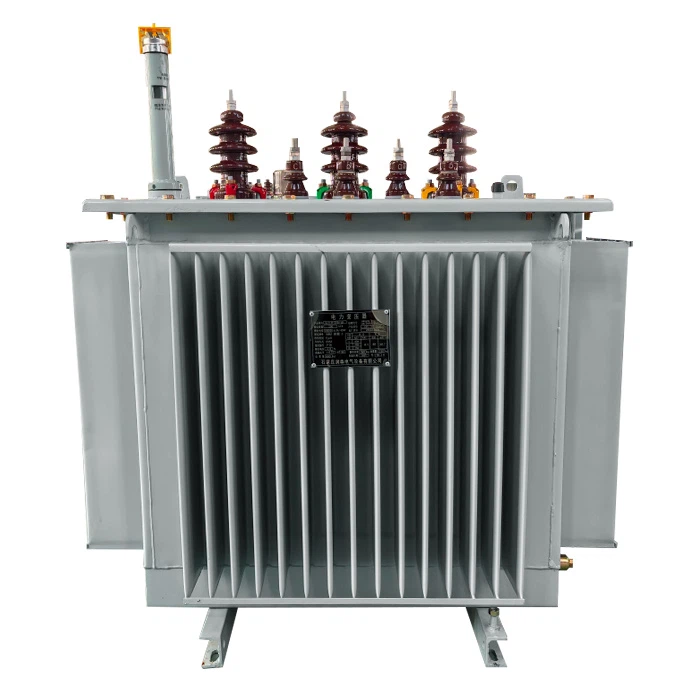
Single-phase transformers use one pair of windings. It’s used in lower-load situations, such as rural areas.
Three-phase transformers are made up of three pairs of windings. The windings typically go around a core sectioned into three parts. Three-phase transformers are used in higher-load areas and can supply three circuits with energy.
Power transformers are designed to handle much higher loads. They can step voltages up or down and transmit a current from one place to another.
Distribution transformers transmit lower voltages from the electrical grid to homes and businesses. They are much smaller than power transformers.
Pole-mounted transformers are connected to an electrical pole.
Pad-mounted transformers are mounted to a concrete pad on the ground.
Key Components of Oil Transformer
Transformer Core
The core is the base of the transformer. It is usually made of thin steel sheets to lower energy loss from eddy currents. The core guides the magnetic flow, which helps transfer energy between the windings.
Windings
Windings are metal coils, often copper or aluminum, wrapped around the core. There are two types: primary and secondary. The primary winding takes in energy, and the secondary sends it out at a different voltage. The number of coil loops decides how much the voltage changes.
Transformer Oil
Transformer oil is very important for oil type transformers. It works as a coolant and an insulator. The oil moves through channels, taking away heat from the core and windings. This cooling is especially needed in big transformers to manage heat.
Voltage Input: AC voltage is applied to the primary winding.
Magnetic Induction: The AC current generates a magnetic field in the core.
Voltage Induction: The magnetic field induces voltage in the secondary winding, stepping it up or down as needed.
Heat Generation
The current flow generates heat due to electrical resistance.
Cooling Process
The insulating oil absorbs heat from the core and windings, transferring it to the cooling fins or radiators.
Heat Dissipation
The oil circulates naturally or through pumps (in larger models), cooling down as it passes through the fins and radiators.
manufacturing process of Oil Transformer
Design and Engineering:
The first step is designing the transformer according to specific customer requirements, voltage levels, and industry standards. Detailed engineering drawings are made for the core, windings, tank, and other components.
Core Manufacturing:
The transformer core is typically made of high-quality electrical steel, cut into thin sheets to minimize energy loss. The core is then assembled in a specific configuration to ensure efficient magnetic flux and low core losses.
Winding Manufacture:
Copper or aluminum wire is used to wind the primary and secondary coils, which are essential for voltage conversion. The windings are carefully designed to ensure proper electrical and thermal performance under load.
Tank and Cooling System:
The transformer tank is fabricated and then welded, ensuring it is airtight and strong. The cooling system, whether natural or forced, is installed to ensure the transformer operates efficiently under different loading conditions.
Assembly:
The core, windings, and tank are assembled together. The insulation materials are added between the windings to prevent short circuits and ensure electrical safety.
Oil Filling:
After assembly, the transformer is filled with high-quality transformer oil that provides both insulation and cooling. The oil is carefully filtered to ensure it is free from impurities and moisture.
Final Testing and Inspection:
Before leaving the factory, the transformer undergoes a series of tests to verify its performance, safety, and compliance with standards.
Application of Oil Transformer
Power Generation and Substations
In power generation, oil-immersed transformers are vital for stepping up the voltage produced by generators to transmission levels. This is essential for reducing energy losses during long-distance transmission. They are also used in substations to step down the voltage for distribution to end-users. The high voltage capacity and efficient cooling of oil-immersed transformers ensure safe and stable operation.
Industrial Facilities
Oil-immersed transformers are widely used in industrial environments, including steel mills, chemical plants, and manufacturing facilities. These locations require a steady and high-capacity power supply, which oil-immersed transformers can reliably provide. The robust design of these transformers can withstand harsh conditions, making them ideal for heavy industrial usage.
Renewable Energy Projects
With the growing adoption of renewable energy, oil-immersed transformers have become a key component in solar and wind power projects. These transformers are used to connect renewable energy sources to the grid, stepping up the voltage for efficient transmission. The ability to handle fluctuating loads makes them suitable for the intermittent nature of renewable energy generation.

FAQ
We're professional oil transformer manufacturers and suppliers in China, specialized in providing high quality products with advanced design. We warmly welcome you to buy oil transformer at competitive price from our factory. For specifications and drawings, contact us now.