

Solar and wind inverters do not produce a clean sine wave. They switch at high frequency to synthesize AC, and the leftover harmonic content runs well past the 50th order into the kilohertz band. A substation transformer selected on fundamental-frequency losses will run hotter than the calculation predicts, and the insulation ages faster than the nameplate life suggests.
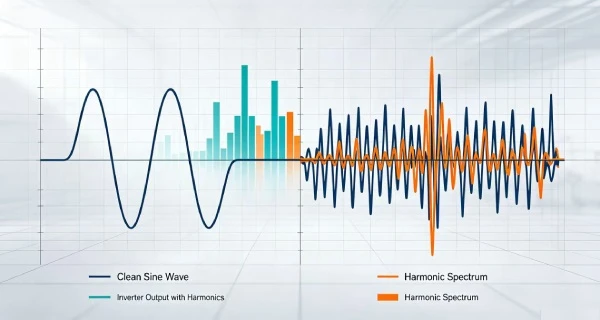
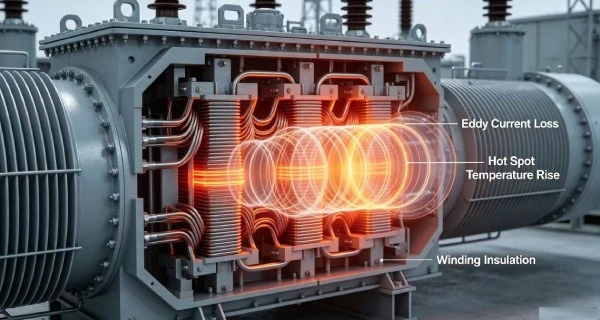
The loss mechanism is eddy current. Higher-order harmonics crowd into the winding conductors and core laminations, raising the eddy loss factor. At a grid-connected solar plant, measurements on a 1.4 MVA inverter transformer showed supra-harmonics in the 2–9 kHz range pushing hot-spot temperature more than 15% above conventional loading, which works out to over 30% more loss-of-life. That is a service-life problem, not a metering curiosity.
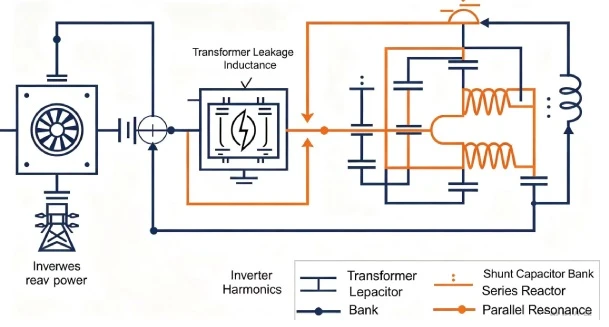
Resonance is the second failure mode, and capacitors are usually involved. Shunt banks installed for power factor correction form a parallel resonant circuit with the transformer's leakage inductance. When the resonant frequency lands near a dominant inverter harmonic, the bank amplifies that harmonic instead of shunting it. IEEE case studies on wind plants found that resonance from underground cabling and capacitor banks deserves more attention than the turbines as harmonic sources. Detuning the bank with a series reactor, or resizing it, solves the problem in principle-but the calculation needs the real harmonic spectrum at the point of common coupling, not catalog values.
When substation transformer harmonic distortion is written into a specification, the harmonic spectrum should be treated as a design input. K-factor ratings provide thermal headroom for non-sinusoidal load, but only if the harmonic profile is known. Hebei Hozee Electric Co., Ltd. manufactures oil-immersed transformers, dry-type transformers, and single-phase transformers, and produces laminated cores and single-phase wound cores in-house. Where substation transformer harmonic distortion is a defined project requirement, we work from the inverter output spectrum and capacitor bank layout rather than a standard catalog number.