

Pole-mounted transformers sit exposed to sun, wind, rain, and load swings that pad-mounted units never see. When one starts running hot or discharging, the clock is already ticking on insulation life. Field crews need a diagnostic sequence that separates a nuisance alarm from a genuine failure in progress.
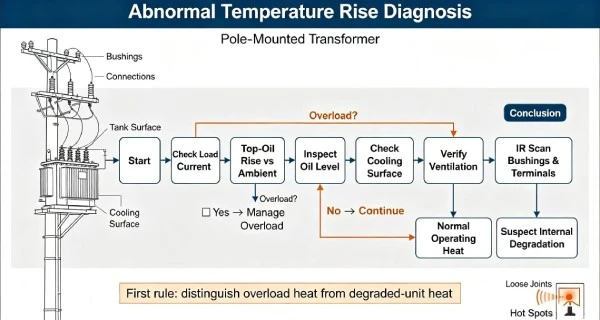
Temperature rise is the first tell. A healthy oil-immersed pole unit under normal load should stay within its designed top-oil rise above ambient. If that gap widens, check load current first-sustained overload is the most common cause on rural feeders with seasonal demand. If loading looks normal but the tank is still hot, suspect cooling surface fouling, low oil level, or blocked ventilation. Infrared scanning of bushings and connections catches loose joints before they escalate. The critical distinction is between a unit running hot because it is working hard and one running hot because something inside has degraded.
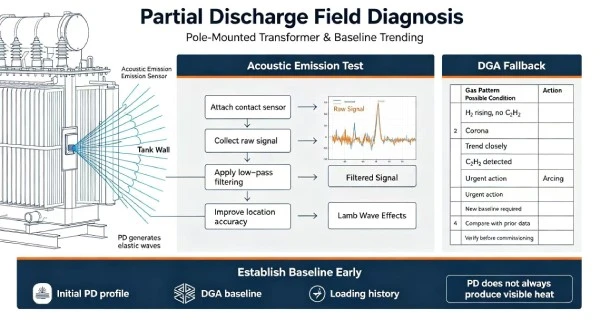
Partial discharge is harder to pin down because it does not always leave visible heat. Acoustic emission detection has proven effective on oil-immersed pole transformers: PD generates elastic waves that travel through the tank wall, and contact sensors held against the enclosure can pick them up without opening the unit. Field experience shows that low-pass filtering improves location accuracy, since the tank's Lamb waves complicate raw signal interpretation. For crews without acoustic gear, dissolved gas analysis remains the fallback-rising hydrogen with no acetylene points toward corona, while acetylene appearing at all means arcing and demands immediate action. The key is establishing a baseline early, not waiting for a failure to start trending.
The diagnostic gap on pole-mounted units is that you cannot easily pull them for lab testing. Hebei Hozee Electric Co., Ltd. builds single-phase pole-mounted transformers with this field reality in mind-core lamination and winding integrity are controlled at our own production lines before the tank is sealed, because once a unit is on the pole, every diagnosis is indirect. We manufacture oil-immersed transformers, dry-type units, and laminated or wound cores in-house, with testing aligned to IEC and GB requirements. For utilities standardizing diagnostic thresholds across a fleet, starting with transformers that hold their baseline is the cheapest reliability upgrade available.