

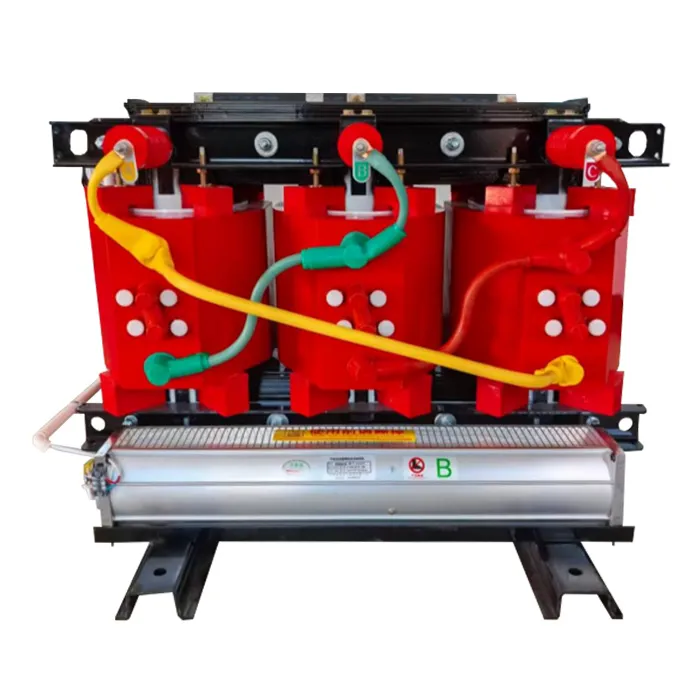
Product Overview
The 100KVA Dry Type Transformer converts 10kV to 400V power at 50Hz using Dyn11 configuration, with forced-air cooling and low-noise vibration isolation.
Application & Selection Guide
1. What Applications Does a 100 kVA Dry-Type Transformer Suit?
A 100 kVA dry-type transformer is a medium-capacity power solution designed for small to medium-sized facilities with moderate to high power demands. It can handle a total connected load of approximately 80 kW to 100 kW (assuming a power factor of 0.8 to 1.0). This makes it ideal for:
Small Factories & Workshops :
Suitable for metal fabrication shops, plastic injection molding workshops, food processing units, woodworking factories, and small assembly lines that operate multiple machines simultaneously, including several large motors, welding equipment, and compressors.
Ideal for community shopping plazas, multi-story small office buildings, supermarkets, restaurants, and hotels that require reliable power for lighting, HVAC systems, elevators, refrigeration, and point-of-sale systems.
Provides stable power for larger schools, training centers, small hospitals, clinics, and diagnostic laboratories with significant lighting, HVAC, and medical equipment loads.
Community & Public Infrastructure :
Serves as a power source for community centers, libraries, municipal buildings, water pumping stations, and telecom base stations with moderate to high power demands.
2. How to Select Input and Output Voltage?
Selecting the correct voltage ratings is the most critical step in ensuring your transformer integrates seamlessly with your grid and equipment. Here is a practical guide:
| Selection Factor | Consideration |
|---|---|
| Primary Voltage (Input) | Match your local grid supply. Common primary voltages for dry-type transformers include 10 kV, 11 kV, 13.8 kV, and 20 kV. Confirm with your utility company before ordering. |
| Secondary Voltage (Output) | Match your equipment requirements. Standard low-voltage outputs are 400V/415V (for 50Hz systems) or 480V/277V (for 60Hz systems). Most industrial and commercial equipment in Europe, Asia, and Africa operates at . |
| Frequency | Confirm whether your grid is 50Hz or 60Hz. This must match the transformer's design frequency. |
| Vector Group | Dyn11 is the most common for distribution transformers. If paralleling with existing transformers, the vector group |
| Tap Changer Range | A ±2*2.5% tapping range on the primary side allows for voltage adjustment to compensate for grid fluctuations. This is a standard feature and recommended for most installations. |
Simple Selection Rule :
Always confirm your grid voltage (primary) and equipment voltage (secondary) with your electrical engineer or utility provider before placing an order. When in doubt, contact our technical team for assistance.
3. Differences Between 100 kVA and 50 kVA Dry-Type Transformers
Choosing the right capacity is a critical decision. Here is a simple comparison to help your customers decide between these two common sizes:
| Consideration Factor | 50 kVA Transformer | 100 kVA Transformer |
|---|---|---|
| Suitable For | Small workshops, single-machine shops, small retail, schools, clinics. Total load ~40-50 kW. | Larger workshops, community plazas, multi-story small offices, supermarkets. Total load ~80-100 kW. |
| Physical Size & Weight | Smaller, lighter, easier to handle and install in very confined spaces. | Larger and heavier; requires more substantial floor space and easier access for installation. |
| Initial Investment | Lower purchase, shipping, and installation costs. Budget-friendly for small projects. | Higher upfront capital expenditure. |
| Operational Losses | Lower absolute losses, resulting in minimum energy waste for its capacity. | Higher absolute losses, leading to greater energy costs over time. |
| Future Load Growth | Limited headroom; adding significant new equipment (e.g., a large machine) may risk overloading. | Offers more spare capacity, allowing for some future expansion (e.g., adding a few more machines or HVAC units) without immediate replacement. |
Simple Selection Rule :
Choose the 50 kVA transformer if your current total calculated load is below 40 kW, your budget and physical space are limited, and you foresee minimal load growth in the next 3-5 years.
Choose the 100 kVA transformer if your load is already close to 50 kW, you have the space, and you plan to expand your operations or add significant new equipment.
Scope of Supply
Product: Cast resin type transformer
Number of phases: Three-phase
Rated power: 30KVA - 3150KVA dry type transformer
Primary voltage: 10,000V
Secondary voltage: 400V
Frequency: 50Hz
Vector Group: Dyn11
Customizable production: Available
Technical Specifications
|
Model |
SCB10-100kVA-10/0.4 |
|
Type |
Dry type Transforme |
|
Standard |
IEC60076 |
|
Rated Power |
100kVA |
|
Frequency |
50HZ |
|
Phase |
Three |
|
Cooling Type |
ANAF |
|
Primary Voltage |
10 KV |
|
Secondary Voltage |
0.4KV |
|
Winding Material |
Copper |
|
Vector Group |
Dyn11 |
|
Impedance |
4% |
|
Tap Changer |
NLTC |
|
Tapping Range |
±2*2.5% @ Primary Side |
|
No Load Loss |
0.4 KW |
|
On Load Loss |
On Load Loss (at 75℃): 1.57 KW |


Engineering Drawings & Layout

Compliance & Certifications
✔ IEC 60076 Standard: Design and type-tested in accordance with IEC 60076 parts 1-11.
✔ ISO 9001:2015 Certified: Audited manufacturing processes with complete traceability from raw material to finished unit.
✔ ISO 14001:2015 Compliant: Environmentally managed production ensuring compliant waste and resource management.
✔ CE Marking Conformity: Certified to meet health and safety standards for European markets.
✔ Type Test Certification: Validated by independent laboratories for short-circuit and temperature limits.
Transformer Process Flow Diagram

Assembly & Quality Control
| Process / Test Item | Technical Method & Data | Quality Result & Impact |
|---|---|---|
| Insulation Screening | 5,000V Megger test applied to all windings before packing. | Confirm high dielectric stability and prevents short circuits. |
| Induced Overvoltage Test | Applied 2x rated voltage at increased frequency per IEC standard. | Verifies inter-turn insulation integrity against transient grid overvoltages. |
| Thermal Monitoring | PT100 sensors verify full-load temperature stays below Class H limits. | Prevents overheating, resulting in stable continuous operation. |
| Partial Discharge Test | Measurement conducted at 1.3x rated voltage; discharge level ≤10 pC. | Prevents localized insulation breakdown, ensuring zero early failures. |
| Torque Verification | All busbar connections tightened via calibrated digital torque wrenches. | Eliminates loose contacts to prevent hot spots and terminal damage. |

FAQ
Q: Can this equipment operate in high-altitude environments?
A: Yes, the design can be modified with specific de-rating factors to operate reliably above 1,000 meters.
Q: How does the factory ensure raw material compliance?
A: All raw materials require MTCs. We conduct inbound sampling tests on copper conductivity, silicon steel core loss (W/kg), and resin viscosity before production release.
Q: How is the equipment protected against moisture during sea freight?
A: Transformers are enclosed in vapor-barrier bags (aluminum foil vacuum packaging) with calculated quantities of silica gel desiccants, then fixed inside IPPC-certified, ISPM 15 compliant seaworthy wooden crates.
Q: Are impact recorders installed during transit?
A: Yes, 3-axis impact recorders are attached to monitor structural acceleration and mechanical shocks during transportation.
Hot Tags: 100kva dry type transformer, China 100kva dry type transformer manufacturers, suppliers, factory, cast coil transformer, 50 kva dry type transformer, dry type cast resin, transformer dry, medium voltage dry type transformers, 2500 kva dry type transformer


