

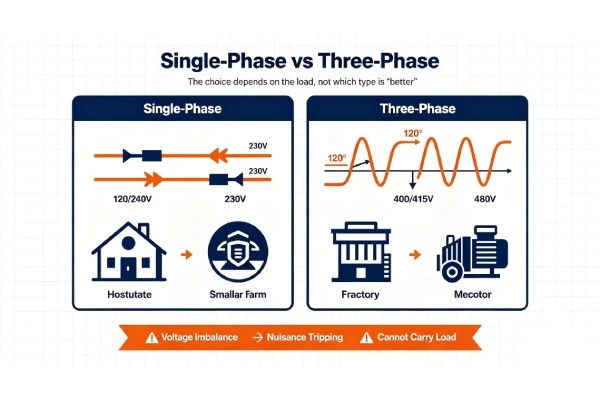
The choice between single-phase and three-phase usually comes down to what you are powering, not which type is "better". A Distribution Transformer in single-phase form is the standard choice for residential and scattered rural loads, while three-phase units serve motor-heavy industrial and commercial sites. Getting this wrong shows up later as voltage imbalance, nuisance tripping, or a unit that simply cannot carry the load.
Supply Arrangement & Typical Loads
A single-phase transformer delivers two lines plus a neutral, giving 120/240V or 230V for lighting, small appliances, and single-phase motors. That matches most homes, small shops, farms, and remote settlements. A three-phase transformer delivers three lines with a 120° displacement, and is what runs large motors, HVAC chillers, elevators, and production machinery. If a site mixes both - a farmhouse plus an irrigation pump, or a shop plus a workshop - the usual practice is a three-phase supply with single-phase loads distributed across the three phases, not two separate transformers.
Installation & Capacity Selection
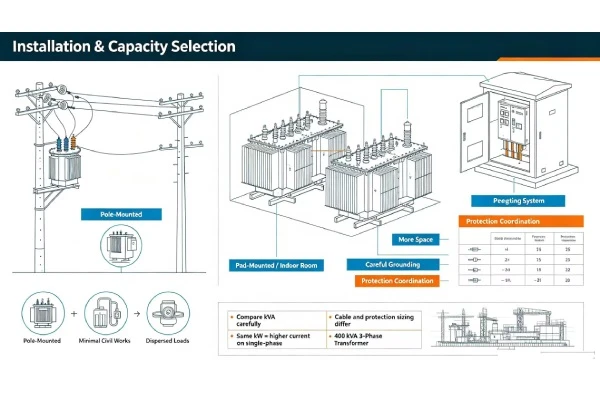
Single-phase units are commonly pole-mounted, which suits overhead rural lines and keeps civil works minimal. A Single Phase Pole Mounted Transformer is therefore the typical specification for dispersed loads along a distribution line, where each unit serves a small cluster of customers. Three-phase units are usually pad-mounted or placed in an indoor electrical room, and need more space, more careful grounding, and protection coordination. On capacity, do not simply compare kVA numbers across the two types - a single-phase load of a given kW draws more current than the same kW spread across three phases, so cable and protection sizing differ. For larger industrial sites, a 400 kVA 3 Phase Transformer is a common step-down choice where motors dominate the load profile.
Grid Parameters to Confirm
Before requesting a quotation, confirm with your utility: available supply type and voltage (single-phase 120/240V, or three-phase 400/415V, 480V), frequency (50 or 60 Hz), whether a neutral is provided, and the fault level at the connection point. Also check whether the site has any large single-phase loads that could cause imbalance - welders and some agricultural equipment are common culprits - because utilities often cap the allowable imbalance. These details determine not just the transformer type but its vector group and tapping range.
About Hebei Hozee Electric Co., Ltd.
Hebei Hozee Electric Co., Ltd. manufactures oil-immersed transformers, dry-type transformers, single-phase transformers, and transformer cores including laminated cores and single-phase wound cores. Because we build both single-phase and three-phase units in-house, we can advise on the supply arrangement before a specification is fixed, rather than after. If you are still deciding between the two types for a project, send us the load list and the utility's supply details, and our engineering team will confirm which configuration fits.