

When choosing a distribution transformer, the two most common types are dry-type (cast resin) and oil-immersed (oil-filled) transformers. While both serve the same basic function, they differ significantly in insulation, cooling, construction, safety, and applications. This article outlines the main differences to help you select the right transformer for your project.
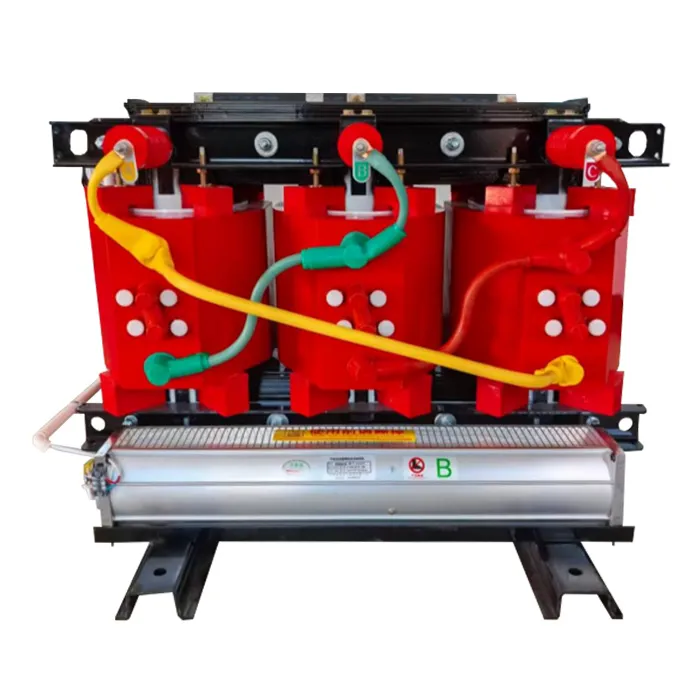
Hozee Electric Manufacturing 100KVA Dry type Transformer
1. Insulation & Cooling Medium
Dry-type transformer: Uses air or epoxy resin as the insulation medium. Heat is dissipated mainly through natural air convection; some models are equipped with fans for forced air cooling.
Oil-immersed transformer: Uses transformer oil (mineral oil or natural ester) as both insulation and cooling medium. Heat is carried away by oil circulation through radiators or cooling fins.
2. Construction & Appearance
Dry-type transformer: The core and windings are either directly exposed or encapsulated in epoxy resin – no oil tank is required. The structure is compact and simple, often housed in a protective metal enclosure.
Oil-immersed transformer: The core and windings are completely sealed inside a steel tank filled with transformer oil. External components include cooling fins, an oil conservator, a Buchholz relay, and a tap changer.
3. Fire & Explosion Safety
Dry-type transformer: Solid insulation (epoxy resin) is flame-retardant and self-extinguishing, with zero risk of oil leakage. It offers high fire and explosion resistance, making it suitable for indoor or crowded areas with strict fire codes.
Oil-immersed transformer: Transformer oil is flammable. In case of internal faults or external fire, oil leakage can lead to fire or even explosion. Fire protection measures such as oil containment pits, fire walls, or deluge systems are required.
4. Overload Capacity & Heat Dissipation
Dry-type transformer: Under natural cooling, heat dissipation is moderate, limiting overload capacity. Forced air cooling can improve overload performance, but dry-type transformers are generally not recommended for continuous heavy loads or high ambient temperatures.
Oil-immersed transformer: Oil provides excellent thermal conductivity and high cooling efficiency, resulting in stronger overload capability. Ideal for high-power, long-duration, or heavy-load industrial applications.
5. Maintenance & Environmental Impact
Dry-type transformer: No regular oil testing or oil replacement is required. Maintenance is limited to dust cleaning, checking the temperature control system, and fans. There is no risk of oil pollution – environmentally friendly.
Oil-immersed transformer: Requires periodic oil sampling to check dielectric strength, moisture content, and acidity. Desiccant (silica gel) needs replacement, and oil may require refilling or filtration. Spent oil must be disposed of as hazardous waste – higher maintenance workload and environmental compliance costs.
6. Typical Applications
Dry-type transformer: Preferred for indoor installations where fire safety, compact size, and low maintenance are critical. Common examples include:
– High-rise buildings, shopping malls, hospitals, schools
– Data centers, subways, basements
– Offshore platforms, community distribution rooms
Oil-immersed transformer: Mainly used outdoors or in dedicated substations. Common scenarios include:
– Municipal roads, industrial parks, heavy manufacturing plants
– Pole-mounted or pad-mounted transformers for utility grids
– Cost-sensitive projects with adequate fire-safe open space
7. Cost & Service Life
Dry-type transformer: Higher initial purchase cost – typically 1.5 to 2 times that of an oil-immersed transformer of the same rating. Under normal operating conditions, service life is approximately 20–25 years.
Oil-immersed transformer: Lower initial cost, offering better value for money. With regular maintenance, service life can reach 25–30 years or more.
So, how do you really choose?
Choose dry-type transformers when your project is indoors, in crowded areas, under strict fire codes, or if environmental friendliness and low maintenance are priorities.
Choose oil-immersed transformers when the transformer will be installed outdoors with fire-safe spacing, under high and continuous loads, and when first cost is a major decision factor.
For specific model quotations or further technical advice, please feel free to contact us. Our engineers can assist you in selecting the right transformer based on your installation environment, load profile, and local regulations.